
'Tis The Schoolboys
When I was in high school, I lived with my friend’s family for a few months while my own family was back east. I felt incredibly indebted to them for allowing me into their home.
What surprised me was that my friend’s mom said that she wanted me to stay with them; that she was hoping I would “rub off” on my friend.
I kind of knew what she meant – I was a good student and worked hard and had pretty good manners. But at the time, I assumed she was just being kind.
Now, 20+ years and two kids of my own later, I finally get what she was saying.
Emerson was right
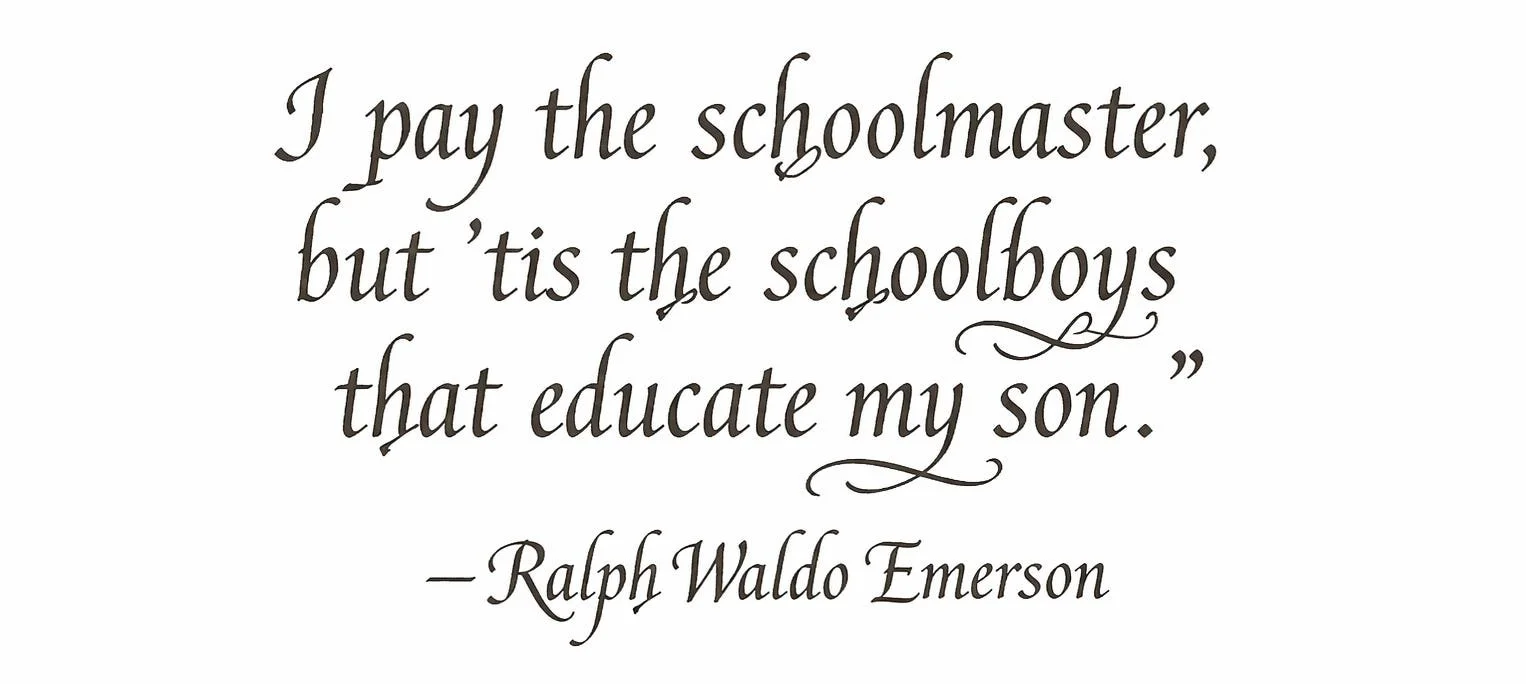
As the master articulator Ralph Waldo Emerson summarized, “I pay the schoolmaster, but ‘tis the schoolboys that educate my son.”
What Emerson understood in the 1800’s – long before we had language like “peer pressure” or “social learning” – was that one’s education isn’t just what’s delivered from the front of the classroom. It’s also something absorbed, constantly and quietly, from peers around us.
I have already seen this power of “the schoolboys” with my own daughters, now three and six years old.
At its best, I see how they absorb good behavior from their peers.
We once had a friend of my daughter’s over for dinner. And while my two girls were arguing over which plate they were going to use, the friend said, matter-of-factly: “It’s just a plate.”
It’s just a plate. Genius.
My kids immediately stopped arguing, looking a little sheepish in the face of this simple logic, and settled down to the plates they were given.
Not only that, but since then those words have become a common refrain in our home when we want to remind each other that something isn’t a big deal or worth getting upset over. This little girl was able to solve in four words what I’d been struggling to teach my daughter for years.
Now, everything has tradeoffs, and the converse is also true: I can also see when my kids are absorbing habits from their friends that are… less desirable.
For every “it’s just a plate” moment, there are just as many moments when I think “where on earth did you learn that?”
We had a phase once where my daughter started speaking a little differently, with a little bit of sass. Some eye rolling entered the picture. It was no surprise when shortly afterwards we spotted the same mannerisms in another girl she had recently befriended. Suffice it to say, it’s always easier to pick up a bad habit than to break one! It took a lot of effort for us to help her unwind those behaviors.
Why does this happen?
We, as a species, are deeply mimetic.
We imitate each other’s desires, behaviors, and even emotions. Babies copy facial expressions within hours of birth and mirror tones of voice and gestures. Imitation is the fastest learning system evolution could design and was crucial back in tribal times when fitting in was a matter of life-and-death.
The brain is wired for mirroring. You may have heard of “mirror neurons,” which activate both when we perform an action and when we watch someone else perform it. When we see someone do something – smile, get scared, etc – our own circuitry jumps into gear, and even more so with one’s age group and peers.
Kids’ brains are especially plastic, with their mirroring systems being hyperactive in early life, and so they are especially susceptible to their peers’ influence. Have you ever seen a kid suddenly take interest in a toy they’d long neglected, just because another kid picked it up? That’s mimetic desire in action.
What’s the lesson?
Our kids are absorbing everything all the time, and their friends have an outsized impact on their little personalities and behaviors.
That’s probably no surprise, but what can we do with that information?
First, it’s nice to know who our kids’ friends are. I like doing drop-off/pick-up/playdates when I can, so that I can put faces to all the names and see the kids in their element, even if just for a few moments.
Because when we see a good friend – one that they love and that we appreciate – we can actively invest in that friendship. We can use our resources – time or effort or money – to do what we can to support these friendships and help them grow (a much better use of my resources than many of the other things I focus on). If you also like the friend’s parents… then those are the real gems!
I was so disappointed last year when I found out that a good friend of my six-year-old’s was moving out of state – this friend was sweet and fun and brought out the best in my daughter. I couldn’t stop her from moving, but I’ve tried my best since then to help the girls stay in touch. We always clear our calendar when the family is back in town, and I encourage my daughter to call the friend and send a card for her birthday. I even bought them “Tin Can” landlines so that they could talk over the phone.
Grown-ups too
The impact of our peers is not limited to kids, of course. Our minds might be less plastic by now, but our own peers have a similar effect.
We’re often told we’re the sum of the five people we spend the most time with, but I think the impact holds even with those friends we see less often.
I personally felt that last weekend when my husband and I stayed at our friends’ house. Aside from the fun of spending time with old friends, I was inspired by my time with them. For one thing, every surface in their house was totally clear, and I could feel myself calm in such a clear space. As soon as my husband and I got home, we de-cluttered our kitchen and have been trying our best to stick to stuff-less counters.
They also inspired me when I saw that their child was able to sit in the car for two-plus hours just looking out the window. “Wow, no screens!” I exclaimed. In our home, the kids know that we don’t watch movies on “short rides,” but that they’re able to if it’s a “long ride,” or, more recently as we’ve been chiseled down, “a medium ride.” Seeing our friend’s son manage the long ride effortlessly without screens gave us courage to try it again in our own household.
Looking forward
This realization – that ‘tis the schoolboys that educate [our] son [and daughters… and ourselves] – is a reminder and a nudge to surround ourselves with people who are worthy of mimicking. Because it’s nice when great friends just appear, but sometimes we have to put ourselves out there, too.
I am so curious to see where my kids’ friendships go – which ones stick, which ones shift, and which ones fall by the wayside.
And the older my children get, the more I suspect Emerson understated his case. We worry about teachers and curricula and “traditional” vs “progressive,” but it may be the child sitting next to ours – the one we didn’t choose at all – who ends up shaping them the most.